
Exsil GFC family · 235 Å
Exsil GFC 3000
High performance size separation of proteins.
Core positioning
Matched efficiency, superior bed stability.
Exsil GFC 3000 has been developed to match the high efficiency of established GFC products such as TSK G3000SWXL while offering superior bed stability and an economical price position.
Technical specifications
Product specifications.
| Phase | Stable High Polarity |
| Working pH range | pH 2 – 7.5 |
| Base silica | Exsil 3000S, high purity silica |
| Particle size | 5 µm |
| Pore size | 235 Å |
| Pore volume | 1.2 cc/g |
| Cat. no. | 60010U — Exsil GFC 3000, 5 µm |
| Cat. no. (base silica) | 60000U — Exsil 3000S, 5 µm silica |
Key benefits
Why Exsil GFC 3000.
High stability
Can be packed at 7000 psi.
High efficiency
Typically 100,000 plates/m for 5 µm.
High recovery
No evidence of protein loss.
Wide applicability
Low adsorption of basic proteins.
Cost effective
High performance at low cost.
Reproducible
Typical Exmere reliability.
1 · Size exclusion range
Similar pore size distribution, distinct selectivity.
Conventional GPC of polystyrenes on Exsil GFC 3000 and TSK G3000SW using THF eluent shows the classic S-shaped curve and a similar pore size distribution, with the Exsil showing a slightly greater population of large pores.
GFC of proteins shows a similar trend at higher molecular weights but increased retention of some lower molecular weight basic proteins on the TSK — possibly due to ionic interaction — culminating in the basic peptide Bacitracin eluting after the apparent void volume.
2 · Protein separations
High efficiency across a broad range of proteins.
The following chromatograms illustrate the high efficiency achieved by these phases, with over 110,000 plates/m for Phenylalanine. Exsil GFC 3000 shows improved resolution of Thyroglobulin from the excluded peak; the basic decapeptide Bacitracin adsorbs on the TSK (Kd 1.08) while eluting at a reasonable Kd of 0.91 on the Exsil.
Thyroglobulin · Ovalbumin · Myoglobin · Phenylalanine
TSK G3000SWXL (A) vs Exsil GFC 3000 (B)
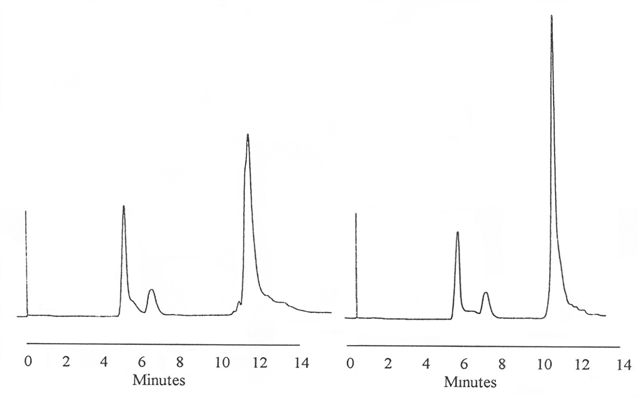
A) 300 × 7.8 mm TSK G3000SWxl and B) 300 × 8 mm Exsil GFC 3000. Eluent: 50 mM potassium phosphate pH 7 / 150 mM sodium chloride at 1.0 mL/min (TSK) and 1.05 mL/min (Exsil).
Reference chromatogram — Exmere technical note.
Ferritin · Bacitracin
Ferritin and Bacitracin — TSK (A) vs Exsil (B)
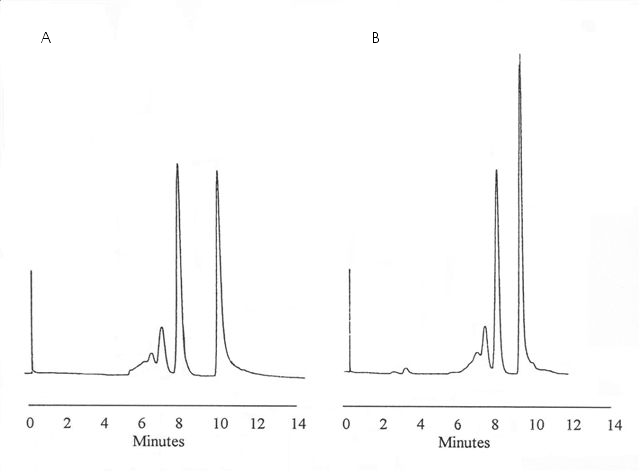
A) 300 × 7.8 mm TSK G3000SWxl and B) 300 × 8 mm Exsil GFC 3000. Same eluent and flow rates as above. Bacitracin apparently adsorbs on the TSK while eluting normally on the Exsil.
Reference chromatogram — Exmere technical note.
Resolution of higher molecular weight BSA aggregates is slightly better on the TSK, but the TSK also shows tailing and excessive retention of the basic Cytochrome C. Overall, Exsil GFC 3000 has an extended high MW range potential and lower adsorptive effects with basic proteins — making it a better proposition for samples of unknown composition.
3 · High speed separations
Higher flow rates, faster analysis, more headroom.
Many GFC phases for medium MW proteins are based on high pore volume silicas with poor mechanical strength and a maximum pressure limit of only 1000 psi — adequate for typical flow rates but leaving no pressure headroom for use or higher-flow quick scans.
Exsil GFC 3000 can be packed at 7000 psi. This allows higher flow rates for faster analysis, faster equilibration of new eluents, and higher headroom for pressure build-up during unattended operation. In the example opposite, Exsil completes the analysis in one third of the time.
Bovine Serum Albumin · Cytochrome C
TSK at 1.0 mL/min (A) vs Exsil at 3.0 mL/min (B)
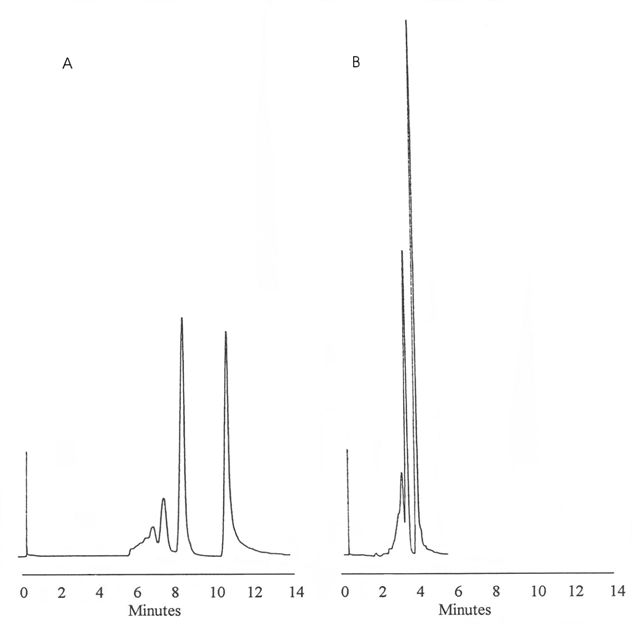
A) 300 × 7.8 mm TSK G3000SWxl at 1.0 mL/min and B) 300 × 8 mm Exsil GFC 3000 at 3.0 mL/min. Same eluent as above. Exsil completes the analysis in approximately one third of the time.
Reference chromatogram — Exmere technical note.
4 · Protein recovery & phase clean-up
Robust to routine use.
Protein recovery
Recovery was assessed using the acidic protein Human Serum Albumin and the basic protein Equine Cytochrome C, using 50 mM potassium phosphate pH 7 / 150 mM sodium chloride eluent. In neither case was there evidence of protein loss.
Phase clean-up
Recommended working pH is 2 – 7.5. Cleaning with 50 column volumes of 50% 10 mM NaOH / 50% MeOH had no effect on column performance. Restricted to 5 column volumes, the column could be cleaned a minimum of 10 times.
Not sure which Exsil GFC phase you need?
Compare the other members of the Exsil GFC family.
Exsil GFC 2000
Smaller-pore GFC phase for the lower MW segment.
- Pore size
- —
- Particle size
- 5 µm
- Application range
- Coming soon
Exsil GFC 4000
For high molecular weight proteins.
- Pore size
- 400 Å
- Particle size
- 5 µm
- Application range
- 60 K – 500 K
Exsil GFC 5000
For very high molecular weight proteins.
- Pore size
- 800 Å
- Particle size
- 5 µm
- Application range
- 150 K – 1250 K