
Exsil GFC family · 800 Å
Exsil GFC 5000
High performance size separation of very high molecular weight proteins.
Core positioning
Completing the range for very high MW proteins.
Exsil GFC 5000 complements the GFC 3000 and GFC 4000 ranges and provides a high efficiency product for very high molecular weight proteins with superior bed stability at an economical price.
Technical specifications
Product specifications.
| Phase | Stable High Polarity |
| Working pH range | pH 2 – 7.5 |
| Base silica | Exsil 5000S, high purity silica |
| Particle size | 5 µm |
| Pore size | 800 Å |
| Pore volume | 1.2 cc/g |
| Cat. no. | 5000GU — Exsil GFC 5000, 5 µm |
| Cat. no. (base silica) | 5000GSU — Exsil 5000S, 5 µm silica |
Key benefits
Why Exsil GFC 5000.
Exceptional stability
Can be packed at 7000 psi.
High efficiency
Up to 100,000 plates/m for 8 mm ID.
High recovery
No evidence of protein loss expected — same bonding as GFC 3000/4000.
Wide applicability
Low adsorption of basic proteins.
Cost effective
High performance at low cost.
Reproducible
Typical Exmere reliability.
1 · Size exclusion range
Optimised for very high MW proteins.
GFC of proteins on Exsil GFC 5000 shifts the retention of proteins to higher Kd values compared to Exsil GFC 3000 and GFC 4000. The optimum operating range is 150 K – 1250 K Daltons, significantly higher than the 60 K – 500 K range of GFC 4000.
Together, the three phases (GFC 3000, 4000 and 5000) cover a broad molecular weight range for protein size separation from around 15 K up to 1250 K.
2 · Protein separations
Resolving Thyroglobulin and other very large proteins.
The large pore size of Exsil GFC 5000 allows the resolution of the high molecular weight Thyroglobulin (MW 670,000), which is partially excluded on smaller pore media.
Thyroglobulin · Riboflavin
250 × 4.6 mm Exsil GFC 5000
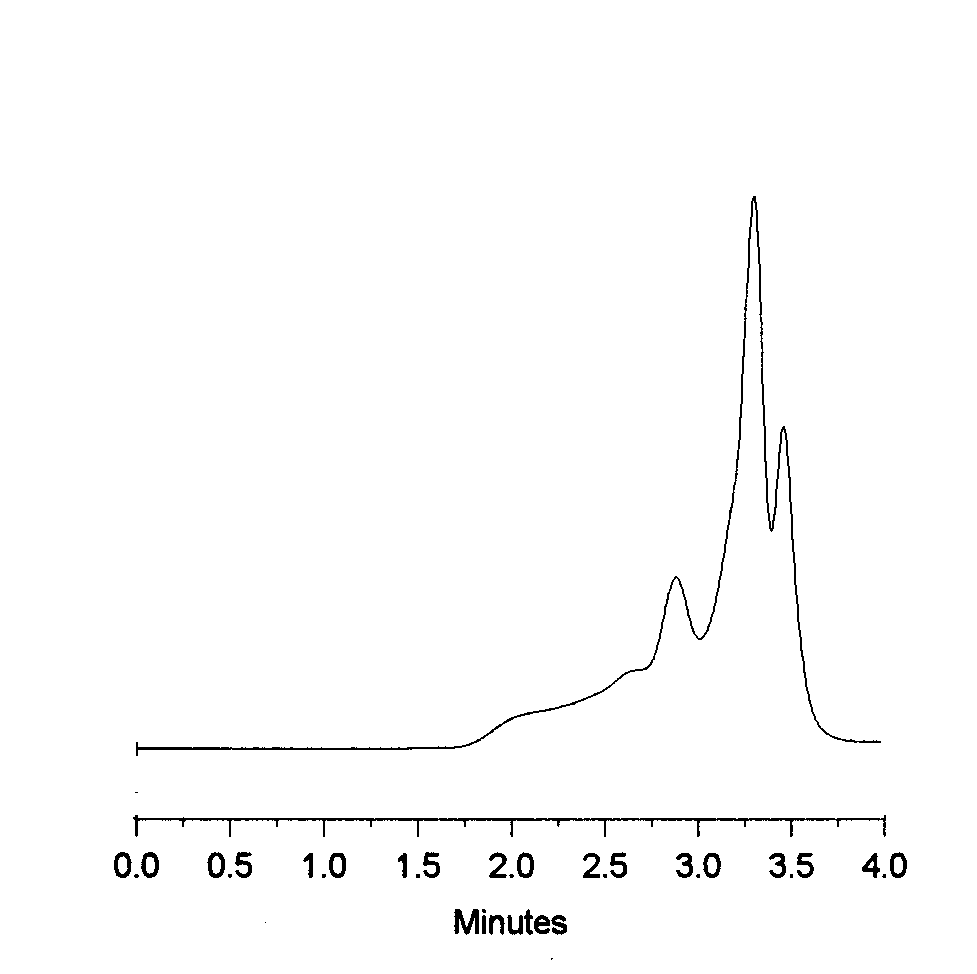
Separation of Thyroglobulin and Riboflavin on 250 × 4.6 mm Exsil GFC 5000 at 1 mL/min using 50 mM potassium phosphate pH 7 / 150 mM sodium chloride eluent.
Reference chromatogram — Exmere technical note.
3 · High speed & high resolution
Mechanical headroom for demanding workflows.
Exsil GFC 5000 retains the excellent mechanical stability of the Exsil GFC 3000 phase and can be packed at 7000 psi and operated at up to at least 3000 psi. This extends the opportunity to carry out either high speed or high resolution separations to very high molecular weight proteins.
The chromatograms show a high speed separation completed on a 250 mm column in 3 minutes and a high resolution separation using three 250 mm columns. In both cases the back pressure was in the region of 2000 – 2500 psi — well within the operating capabilities of Exsil GFC 5000, but around twice the maximum limit of some competitive materials.
Thyroglobulin · Ovalbumin · Phenylalanine
250 mm column (A) vs 750 mm column stack (B)
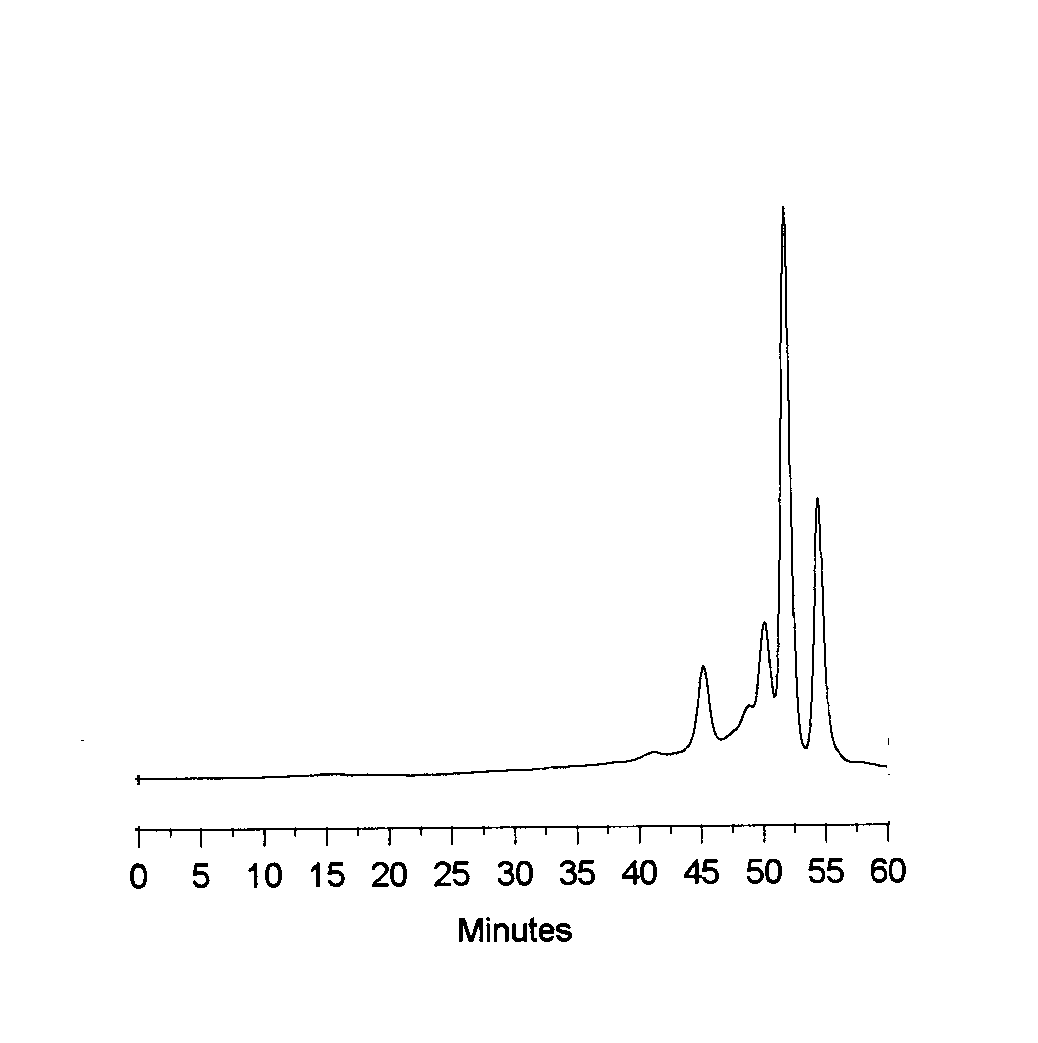
A) 250 × 4.6 mm Exsil GFC 5000 at 1 mL/min and B) 750 × 4.6 mm Exsil GFC 5000 at 0.33 mL/min. Eluent: 50 mM potassium phosphate pH 7 / 150 mM sodium chloride.
Reference chromatogram — Exmere technical note.
4 · Protein recovery & phase clean-up
Same bonding, same expected robustness.
Based on the same bonding as the Exsil GFC 3000 / 4000 series, similar high protein recovery combined with resistance to high pH cleaning can be expected on Exsil GFC 5000.
Not sure which Exsil GFC phase you need?
Compare the other members of the Exsil GFC family.
Exsil GFC 2000
Smaller-pore GFC phase for the lower MW segment.
- Pore size
- —
- Particle size
- 5 µm
- Application range
- Coming soon
Exsil GFC 3000
For protein size separation in the lower to medium MW range.
- Pore size
- 235 Å
- Particle size
- 5 µm
- Application range
- 15 K – 60 K
Exsil GFC 4000
For high molecular weight proteins.
- Pore size
- 400 Å
- Particle size
- 5 µm
- Application range
- 60 K – 500 K